George Town, Prayagraj, U.P.211002
Welcome to Dr. Aditi's Fetal Medicine Centre

Welcome to Dr. Aditi's Fetal Medicine Centre
George Town, Prayagraj, U.P.211002
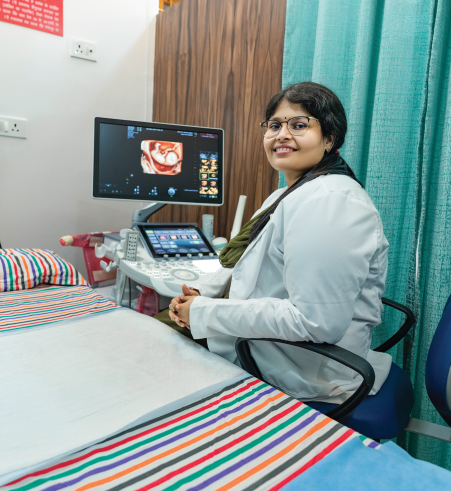


Dr. Aditi Dubey(M.B.B.S, M.S.(OBG)) is one of the specialized doctors in fetal-maternal medicine in Prayagraj. Also, we provide complete care to all our dearie female patients, with a range of fetal treatments that correlates to the advanced technology in fetal medicine.
" Dr. Aditi Dubey" is such a kind doctor. They allow us to view live images while scanning. The most important thing, she explained everything in detail while scanning, so we could understand the results.& No monopoly-based talks… Also, the assisting staff is also very cooperative.

Customer
Best fetology clinic in Prayagraj. The doctor is very gentle & humble in nature.. explained in detail... gives you enough time to understand the situation... all staff is co-operative.
Customer
Aditi’s Fetal Medicine is one of the best centers for any fetal medicine. Dr. Aditi is extremely knowledgeable in diagnosis as well as treatment. She is a good listener. The clinic is well-maintained neat and clean. Full marks for treatment and maintenance of hygiene.
Customer
I started my treatment with Dr. Aditi at Aditi’s Dubey Fetal Medicine Care. I have delivered a beautiful baby girl because of her guidance and her fabulous consultation. Her nature is too good and she is really supportive and hears all our issues patiently. The staff of the hospital is also very cooperative and supportive.
Customer
Dr. Aditi explains all the disease-related issues very well and guides us properly regarding the same. Also, the staff is also very cooperative. I'll always be grateful to Dr. Aditi coz she is the best.
Customer
Fetal Medicine
Award Win
Years Of Experience
Happy Patients
Prenatal yoga is the best practice for childbirth. And if you are looking for a blog then check out if this prenatal yoga is right for you.
A stillbirth is the death or demise of a fetus before or at the time of delivery. Despite being similar to a miscarriage, they differ
General information about prenatal care and diagnosis. It is not a substitute for advice about your own pregnancy, which should come from the doctor treating you.
Usually between 6 and 8 weeks, to confirm that the pregnancy is inside the uterus, establish how many weeks along it is, check the heartbeat and see whether there is more than one baby. Dating is most accurate in the first trimester, and an accurate due date affects the timing of every later test, so an early scan is worth having even in a straightforward pregnancy.
They are distinguished by training and by the questions they answer. A radiologist is trained in imaging across the whole body and may or may not subspecialise in obstetrics. A sonologist is a doctor who performs and reports ultrasound scans. A fetal medicine specialist is an obstetrician with further training in prenatal diagnosis who also manages the pregnancy clinically, counsels on findings and performs diagnostic procedures.
Three linked activities. Screening estimates the chance of a condition using ultrasound measurements and blood tests. Detailed imaging examines the baby’s anatomy system by system. Diagnostic testing analyses the baby’s own cells to confirm or exclude a specific condition. Counselling runs through all three, because the point is not simply to generate results but to help a family understand and act on them.
Look at registration, training and the report. The centre should be registered under the Pre-Conception and Pre-Natal Diagnostic Techniques Act, 1994. The person scanning should hold recognised qualifications and, for specific studies such as nuchal translucency or fetal echocardiography, certification for that examination. The report should say what was examined and what could not be assessed, and enough time should be allowed for the scan to be done properly.
Coverage varies and cannot be assumed. Many policies exclude outpatient investigations, and maternity benefits often carry a waiting period and apply mainly to hospitalisation and delivery rather than to routine scans. Some corporate group policies are more generous. It is worth checking the specific policy wording early in the pregnancy rather than at the point of payment.
Every scan report and image, all blood test and screening results, the dating scan report, vaccination records, notes on any medicines taken and when, and discharge summaries from previous pregnancies. Keeping them together in one file, in date order, is more useful than it sounds. Interpretation of a later scan often depends on being able to compare it directly with an earlier one.
Often yes, for the standard screening scans at least. The first-trimester screening scan and the mid-pregnancy anomaly scan are the two examinations where specialist-level assessment adds most, and both are offered to all pregnancies rather than only to high-risk ones. Beyond those, routine care with the treating obstetrician is usually sufficient unless something specific arises.
Yes. Prenatal testing lowers uncertainty but never removes it. Some conditions develop after the scans are done, some are too subtle to see, and metabolic, hearing, vision and developmental conditions largely cannot be detected by imaging at all. Honest prenatal care sets out what a test can and cannot establish rather than implying that a normal result guarantees a healthy baby.