George Town, Prayagraj, U.P.211002
Welcome to Dr. Aditi's Fetal Medicine Centre

Welcome to Dr. Aditi's Fetal Medicine Centre
George Town, Prayagraj, U.P.211002
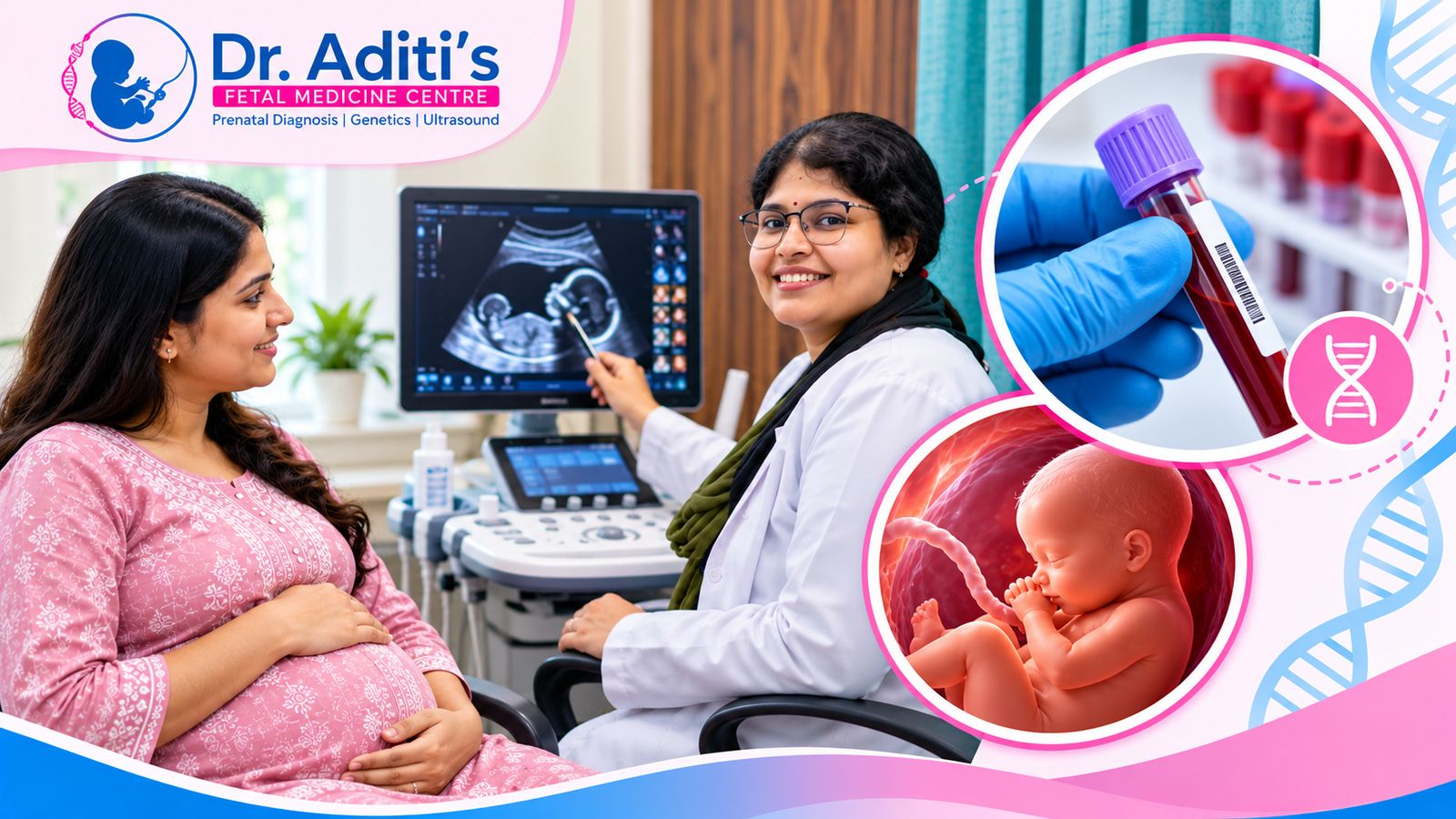
The NIPT test in Prayagraj is a prenatal blood screening test available from around 10 weeks of pregnancy. It helps estimate the likelihood of chromosomal conditions such as Down syndrome, Edwards syndrome, and Patau syndrome. NIPT offers highly accurate screening for common trisomies without an invasive procedure, but it cannot provide a confirmed diagnosis.
Pregnancy involves several important decisions about prenatal screening. Parents often want to understand whether their baby is developing normally, which tests are recommended, and whether additional screening is necessary.
Non-Invasive Prenatal Testing (NIPT) provides valuable information about selected chromosomal conditions through a simple maternal blood sample.
At Dr. Aditi Fetal Medicine Centre, expectant parents can discuss available prenatal screening options and understand which tests may be appropriate for their pregnancy.
Non-Invasive Prenatal Testing, commonly called NIPT, is a screening method that examines cell-free DNA circulating in a pregnant woman’s bloodstream.
During pregnancy, DNA fragments originating mainly from the placenta enter the maternal blood. Laboratories analyse these fragments to estimate the likelihood of certain fetal chromosomal abnormalities.
NIPT primarily screens for three conditions:
Some expanded screening panels include sex chromosome conditions or selected microdeletions. However, additional screening is not always medically necessary, and routine screening for microdeletions is generally not recommended.
NIPT does not require a needle to enter the uterus. Only a maternal blood sample is collected, making it a non-invasive screening option.
According to the American College of Obstetricians and Gynecologists (ACOG), prenatal genetic screening helps estimate the chance of certain genetic conditions but cannot confirm a diagnosis.
NIPT can be offered to pregnant women of different ages and risk categories after appropriate counselling.
The following situations may make a discussion about NIPT particularly useful.
The likelihood of certain chromosomal abnormalities increases with maternal age.
Women aged 35 years or older at the expected delivery date may consider NIPT for more accurate screening.
However, younger pregnant women can also choose NIPT. Maternal age alone does not determine whether screening should be offered.
A double marker test combined with NT ultrasound findings can estimate the chance of certain chromosomal abnormalities.
When combined screening indicates an increased risk, NIPT may be considered as a secondary screening option in selected circumstances.
However, diagnostic testing may be more appropriate when the screening risk is substantially elevated or ultrasound abnormalities are present.
Parents who previously experienced a pregnancy affected by a chromosomal abnormality may benefit from genetic counselling.
Depending on the previous diagnosis, the specialist may discuss NIPT or recommend diagnostic testing.
Some parents prefer NIPT because of its high detection rate and comparatively low false-positive rate for common trisomies.
The decision should be made after understanding the benefits, limitations, and possible need for further testing.
Increased nuchal translucency or structural abnormalities on ultrasound require specialist evaluation.
In these situations, diagnostic testing may be more informative than NIPT alone.
For further information, visit the Down syndrome screening service.
NIPT offers several advantages when used as part of appropriate prenatal screening.
NIPT detects more than 99% of Down syndrome pregnancies in many validated testing settings.
It generally performs better than traditional serum screening for common trisomies.
The test can usually be performed from 10 completed weeks of pregnancy, allowing parents to receive screening information during the first trimester.
NIPT requires a maternal blood sample. The procedure does not involve entering the uterus and does not carry the procedure-related miscarriage risk associated with invasive prenatal testing.
Compared with conventional serum screening, NIPT generally produces fewer false-positive results for common trisomies.
This can reduce unnecessary anxiety and the number of patients requiring follow-up diagnostic procedures.
Screening results can help parents and clinicians decide whether genetic counselling, additional ultrasound assessment, or diagnostic testing is needed.
However, NIPT cannot detect every genetic disorder or structural birth defect.
The NIPT test in Prayagraj can generally be performed from 10 completed weeks of pregnancy.
Before this stage, the amount of placental cell-free DNA in maternal blood may be insufficient for reliable analysis.
The following timeline explains how NIPT fits into prenatal care.
| Pregnancy Stage | Recommended Assessment |
|---|---|
| Before 10 weeks | Pregnancy dating and screening counselling |
| From 10 weeks | NIPT blood screening |
| 11–13 weeks + 6 days | First-trimester ultrasound and NT assessment when indicated |
| Around 18–22 weeks | Detailed fetal anatomy scan |
NIPT does not replace ultrasound examinations.
Ultrasound assessments help evaluate fetal growth, anatomy, and structural development, while NIPT focuses on selected chromosomal conditions.
Read more about the NT scan during pregnancy.
NIPT is one of the most accurate prenatal screening methods available for common fetal trisomies.
However, screening performance varies depending on the chromosomal condition, laboratory technology, fetal fraction, and pregnancy characteristics.
| Chromosomal Condition | Approximate Detection Sensitivity |
|---|---|
| Down syndrome (Trisomy 21) | More than 99% |
| Edwards syndrome (Trisomy 18) | Around 97–99% |
| Patau syndrome (Trisomy 13) | Around 90–97% |
These are general estimates rather than guaranteed performance figures for every laboratory.
Importantly, sensitivity is different from the probability that a positive result is correct.
The positive predictive value depends on factors including the underlying chance of the condition in the pregnancy.
Yes. Although NIPT is highly accurate, false-positive and false-negative results can occur.
Possible contributing factors include:
NIPT results should always be interpreted alongside clinical history and ultrasound findings.
The MedlinePlus guide to noninvasive prenatal testing also explains why NIPT is considered a screening test rather than a diagnostic test.
No.
A high-risk NIPT result indicates an increased likelihood of the screened condition.
Confirmatory diagnostic testing, such as chorionic villus sampling (CVS) or amniocentesis, should be offered before making irreversible pregnancy decisions.
The comparison of nipt vs double marker test is important because both are commonly discussed during first-trimester prenatal screening.
Although both estimate chromosomal risk, they use different testing methods.
| Feature | NIPT | Double Marker Screening |
|---|---|---|
| Testing method | Cell-free DNA analysis | Maternal blood biochemical markers |
| Timing | From around 10 weeks | Usually 11–13 weeks + 6 days as part of combined screening |
| Down syndrome detection | More than 99% | Approximately 80–90% when combined with NT and maternal factors |
| False-positive rate | Generally lower | Generally higher |
| Cost | Usually higher | Usually lower |
| Diagnostic confirmation | Required after a high-risk result | Required after a high-risk result |
NIPT is generally the more accurate screening option for common trisomies.
However, combined first-trimester screening remains a valid choice, particularly when cost and availability are important considerations.
Patients should discuss their options with a fetal medicine specialist rather than undergoing multiple independent screening tests without a clear clinical reason.
Read the double marker test guide for more information.
The nipt test cost in prayagraj varies depending on the laboratory, screening panel, sample processing, and services included.
A standard NIPT panel generally screens for trisomies 21, 18, and 13.
Expanded panels may include additional chromosomal conditions, although wider screening does not automatically mean better clinical care.
Several factors influence the price.
Standard screening panels are usually less expensive than expanded panels.
Laboratories may use different validated technologies, quality-control processes, and reporting systems.
When samples are transported to a reference laboratory, handling and transportation arrangements may affect the total charge.
Some providers include pre-test counselling or result interpretation in the quoted price, while others charge separately.
When planning an NIPT test in Prayagraj, parents should compare the clinical suitability of the test rather than choosing solely based on price.
Cost information: The exact price range should be confirmed directly with Dr. Aditi Fetal Medicine Centre. Laboratory arrangements and package charges may change.
NIPT usually requires very little preparation.
The process generally involves the following steps.
The specialist reviews gestational age, ultrasound reports, previous screening results, and relevant pregnancy history.
The doctor explains what NIPT can detect, its limitations, and whether diagnostic testing might be more appropriate.
A small maternal blood sample is collected from an arm.
Fasting is generally not required unless the healthcare provider has advised another test that requires it.
The blood sample is processed by a laboratory that analyses placental cell-free DNA.
The clinician explains the screening result and discusses whether any additional assessment is required.
Many laboratories provide results in approximately 5–10 working days.
However, the actual reporting period depends on the testing laboratory, sample transportation, and quality-control requirements.
The expected turnaround time should be confirmed with the clinic before sample collection.
NIPT reports usually describe a low-risk or high-risk result. Occasionally, the laboratory may be unable to issue a result.
A low-risk result means the likelihood of the screened chromosomal conditions is reduced.
It does not guarantee that the baby has no genetic or structural abnormalities.
Recommended ultrasound examinations and routine pregnancy care should continue.
A high-risk result means that a particular chromosomal condition is more likely.
The doctor may recommend genetic counselling, a detailed ultrasound, and confirmatory diagnostic testing.
Sometimes the laboratory cannot produce a reliable result because of low fetal fraction or other technical and biological factors.
A no-result report requires clinical review. Depending on the circumstances, repeat NIPT or diagnostic testing may be discussed.
An inconclusive result should not automatically be treated as normal.
Parents considering a non invasive prenatal test in prayagraj can consult Dr. Aditi Fetal Medicine Centre for prenatal screening guidance.
Choosing the appropriate test depends on several factors, including gestational age, maternal history, ultrasound findings, and previous screening results.
A fetal medicine consultation can help parents understand:
At Dr. Aditi Fetal Medicine Centre, patients can discuss prenatal screening decisions and appropriate follow-up care.
Laboratory availability, sample collection arrangements, reporting time, and current charges should be confirmed with the centre.
The NIPT test in Prayagraj is an important prenatal screening option for parents seeking accurate information about common fetal chromosomal conditions.
Available from around 10 weeks of pregnancy, it provides highly accurate screening for Down syndrome and certain other trisomies through a maternal blood sample.
However, NIPT remains a screening test and cannot replace diagnostic testing when confirmation is necessary.
At Dr. Aditi Fetal Medicine Centre, expectant parents can discuss available prenatal screening options, understand their results, and plan appropriate follow-up care.
Book a prenatal screening consultation to discuss whether NIPT is suitable for your pregnancy.
Yes. NIPT requires only a maternal blood sample and does not directly disturb the pregnancy. Minor discomfort or bruising may occur at the blood collection site.
Most laboratories recommend NIPT from 10 completed weeks. Testing earlier may lead to insufficient placental cell-free DNA and an inconclusive result.
No. NIPT has a detection sensitivity exceeding 99% for Down syndrome in many validated settings, but false-positive and false-negative results remain possible. Diagnostic testing is required to confirm a high-risk result.
NIPT analyses placental cell-free DNA, while double marker screening measures maternal blood markers and is usually combined with ultrasound findings. NIPT generally provides higher screening accuracy for common trisomies.
The cost depends on the selected screening panel, laboratory, and services included. Patients should contact the clinic to confirm the current price, available panels, and whether counselling is included.
Ultrasound assessment during early pregnancy remains important even after low-risk NIPT. However, a dedicated NT measurement solely for chromosomal risk calculation is not necessarily required following a negative NIPT result. Your specialist can advise which ultrasound assessments are appropriate.