George Town, Prayagraj, U.P.211002
Welcome to Dr. Aditi's Fetal Medicine Centre

Welcome to Dr. Aditi's Fetal Medicine Centre
George Town, Prayagraj, U.P.211002
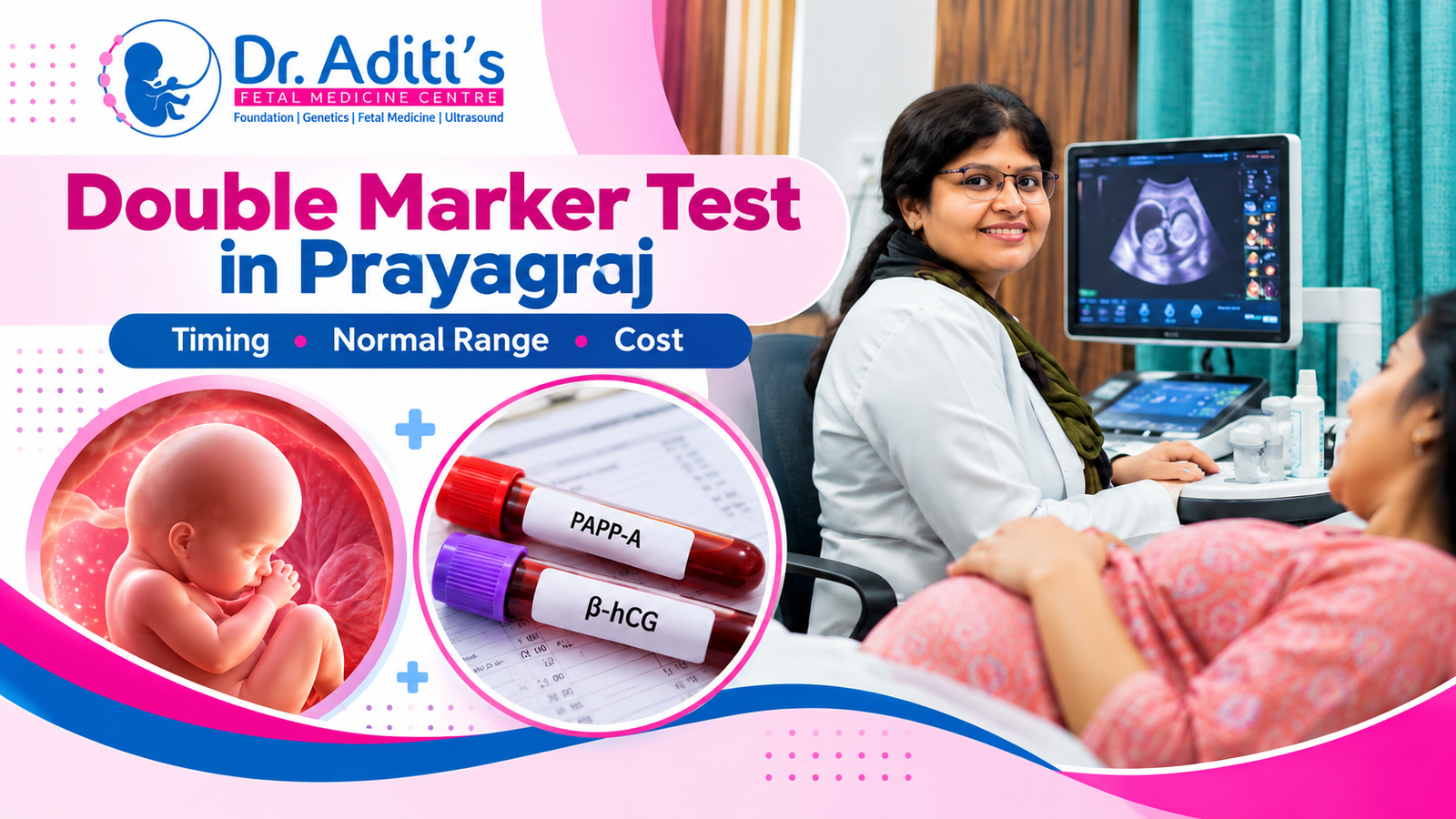
The double marker test in Prayagraj is an important first-trimester prenatal screening test that helps assess the likelihood of certain chromosomal conditions in a developing baby. It measures two substances in the mother’s blood and is commonly combined with an NT scan between 11 weeks and 13 weeks plus 6 days of pregnancy.
This screening helps doctors estimate the chance of conditions such as Down syndrome, Edwards syndrome and Patau syndrome. However, it does not confirm whether a baby has a chromosomal condition.
Understanding the timing, procedure, normal range, accuracy and cost of the double marker test can help expecting parents make informed decisions about their pregnancy.
The double marker test in Prayagraj is a maternal blood screening test performed during early pregnancy. It measures two biochemical markers associated with pregnancy and placental development.
These markers include:
1. Free Beta-hCG (Human Chorionic Gonadotropin)
Free beta-hCG is a hormone produced during pregnancy. Its levels contribute to the assessment of chromosomal risk when interpreted with other screening information.
2. PAPP-A (Pregnancy-Associated Plasma Protein-A)
PAPP-A is a protein produced mainly by placental tissue. Lower levels may be associated with certain chromosomal abnormalities and some pregnancy complications.
The laboratory combines these marker levels with maternal age, gestational age and other relevant information to calculate a screening risk.
When combined with an NT ultrasound, the test provides a more informative first-trimester screening assessment.
The ideal time for combined first-trimester screening is generally between 11 weeks and 13 weeks plus 6 days of pregnancy.
Pregnant women planning a double marker test in Prayagraj should discuss the screening schedule with their obstetrician or fetal medicine specialist during an early pregnancy appointment.
The blood collection window may vary depending on the laboratory’s validated screening protocol.
| Pregnancy stage | Screening recommendation |
|---|---|
| Before 10 weeks | Confirm pregnancy dating and discuss screening options |
| 11–13 weeks + 6 days | Common window for combined NT scan and double marker screening |
| 14–20 weeks | Discuss second-trimester screening options if first-trimester screening was missed |
| After 20 weeks | Consult a specialist about appropriate ultrasound and further investigations |
An accurate pregnancy dating scan is important because gestational age affects the interpretation of blood marker levels.
For more information, read about the Nuchal Translucency Scan.
The double marker test in Prayagraj helps identify pregnancies that may require additional evaluation for chromosomal conditions.
The test can help with:
A lower-chance result is reassuring but does not guarantee that the baby has no chromosomal or structural condition.
Similarly, a higher-chance result does not mean the baby definitely has a chromosomal abnormality.
The purpose of screening is to provide information that helps parents and healthcare professionals decide whether further assessment is appropriate.
The double marker test is a simple maternal blood test. It does not require a sample from the baby or the amniotic fluid.
The usual process involves five steps.
The doctor reviews the mother’s medical history, pregnancy duration and relevant previous reports.
An NT scan measures the fluid-filled space behind the baby’s neck. This measurement contributes to combined first-trimester risk assessment.
A healthcare professional collects a small blood sample from a vein in the mother’s arm.
The laboratory measures free beta-hCG and PAPP-A and calculates the screening risk using the appropriate algorithm.
The doctor reviews the blood test report together with the ultrasound findings and maternal information.
The blood collection procedure usually takes only a few minutes. The reporting time depends on the laboratory.
Patients scheduling a double marker test in Prayagraj should confirm whether the blood sample is collected at the centre or through an associated laboratory.
Many expecting parents want to know the normal range of the double marker test.
However, there is no single universal normal value that applies to every pregnancy.
The laboratory may report blood marker levels using multiples of the median, commonly called MoM.
A MoM value compares the measured level with the expected median for a particular gestational age, with adjustments where appropriate.
| Marker | Interpretation |
|---|---|
| PAPP-A | Lower values may contribute to an increased calculated risk of certain chromosomal conditions |
| Free beta-hCG | Higher or lower values may influence the calculated risk depending on the condition |
| NT measurement | Increased nuchal translucency may require additional assessment |
| Combined screening risk | Estimated probability calculated from multiple screening factors |
A MoM value of approximately 1.0 represents the reference median. It is not a universal cutoff separating normal and abnormal pregnancies.
A screening report may include risk ratios such as:
For example, a risk of 1:100 represents an estimated 1% chance of the specified condition.
A risk of 1:1,000 represents an estimated 0.1% chance.
The cutoff used to classify a result as higher or lower chance depends on the screening programme.
When interpreting a double marker test in Prayagraj, doctors consider the complete risk calculation rather than relying on an individual marker value.
The double marker test cost in Prayagraj varies depending on the laboratory, screening package and additional services included.
The overall cost may depend on:
Some providers offer combined first-trimester screening packages, while others charge separately for the blood test and NT scan.
Before booking a double marker test in Prayagraj, ask whether the quoted amount includes the NT scan, blood sample collection, laboratory analysis and consultation.
The exact current charges at Dr. Aditi Fetal Medicine Centre have not been confirmed. Patients should contact the centre directly for an updated quotation.
Different prenatal screening tests are available during different stages of pregnancy.
| Feature | Double marker | Triple marker | Quadruple marker |
|---|---|---|---|
| Pregnancy stage | First trimester | Second trimester | Second trimester |
| Common timing | 11–13 weeks + 6 days for combined screening | Around 15–20 weeks | Around 15–22 weeks |
| Blood markers | Free beta-hCG and PAPP-A | AFP, hCG and unconjugated estriol | AFP, hCG, unconjugated estriol and inhibin A |
| Main purpose | Early chromosomal risk screening | Second-trimester screening | Second-trimester screening |
| NT scan | Commonly combined | Not part of the test | Not part of the test |
The triple marker test in Prayagraj may be discussed when a pregnant woman has missed the first-trimester screening window.
The quadruple marker test in Prayagraj includes an additional blood marker and generally provides better Down syndrome screening performance than the triple marker test.
The choice of screening should depend on gestational age, previous investigations and medical advice.
Pregnant women should not undergo multiple independent screening tests without a coordinated plan because this may increase false-positive findings.
The accuracy of the double marker test in Prayagraj depends on the screening method, laboratory analysis, maternal characteristics and whether ultrasound findings are included.
Combined first-trimester screening can identify approximately 80–90% of pregnancies affected by Down syndrome, depending on the screening protocol and false-positive rate.
However, no screening test is completely accurate.
A false-positive result occurs when screening indicates an increased chance of a chromosomal condition, but the baby does not have that condition.
A false-negative result occurs when screening indicates a lower chance even though the baby has the condition.
A screening test estimates risk; it does not provide a definitive diagnosis.
For more information, visit Screening for Aneuploidies.
A higher-chance screening result does not confirm that the baby has a chromosomal abnormality.
A fetal medicine specialist may recommend further counselling and investigations based on the result.
A detailed ultrasound evaluates fetal anatomy and looks for findings that may influence the need for additional investigations.
NIPT analyses cell-free DNA in maternal blood to screen for certain chromosomal conditions.
It generally provides higher screening accuracy for common trisomies than conventional serum screening, but it remains a screening test.
CVS is a diagnostic procedure that collects placental tissue for genetic analysis.
It is generally performed from 11 weeks onward in an appropriate clinical setting.
Amniocentesis is a diagnostic procedure involving the collection of amniotic fluid for laboratory testing.
It is generally performed from 15 weeks onward.
CVS and amniocentesis carry procedural risks that should be discussed with the treating specialist.
The appropriate next step depends on pregnancy duration, ultrasound findings, screening results and parental preferences.
First-trimester chromosomal screening should be discussed with all pregnant women, regardless of maternal age.
It may be especially relevant for women who:
Younger pregnant women can also have pregnancies affected by chromosomal abnormalities.
The decision to undergo screening is personal and should follow informed counselling about the available options.
The double marker test evaluates biochemical markers in maternal blood, while the NT scan measures the fluid behind the baby’s neck.
Combining these findings with maternal characteristics provides a more informative screening risk estimate.
The NT scan also helps assess early fetal development and confirm pregnancy dating.
Patients considering a double marker test in Prayagraj should discuss whether combined first-trimester screening is appropriate for their pregnancy.
For further information, read NT Scan in Pregnancy.
At Dr. Aditi Fetal Medicine Centre, Dr. Aditi Dubey provides fetal medicine expertise for prenatal assessment and counselling.
Expecting parents can discuss first-trimester ultrasound assessment, chromosomal screening options and the interpretation of prenatal screening results.
During a consultation, the doctor can help patients understand:
Patients seeking a double marker test in Prayagraj should confirm test availability, sample collection arrangements, consultation requirements and current charges directly with the centre.
Website: Dr. Aditi Fetal Medicine Centre
The double marker test in Prayagraj helps expecting parents assess the chance of certain chromosomal conditions during early pregnancy. When combined with an NT scan, it provides useful information for first-trimester prenatal screening.
Understanding the appropriate timing, normal range, accuracy and possible next steps can help parents make informed decisions.
For personalised guidance, consult Dr. Aditi Dubey at Dr. Aditi Fetal Medicine Centre to discuss suitable prenatal screening options and interpretation of results.
Combined first-trimester screening is commonly performed between 11 weeks and 13 weeks plus 6 days of pregnancy. The precise blood collection window depends on the screening protocol.
There is no single universal normal range. Laboratories interpret PAPP-A, free β-hCG and other factors using adjusted values and a calculated risk ratio. Your doctor should interpret the complete report.
The price varies according to the laboratory and whether the NT scan and consultation are included. Contact the chosen centre for a current quotation and confirm whether blood collection is available on-site.
No. It is an optional prenatal screening test. Healthcare professionals should explain its benefits, limitations and alternatives so that expecting parents can make an informed decision.
A screen-positive or higher-chance result does not confirm a chromosomal abnormality. Your specialist may recommend counselling, NIPT, detailed ultrasound or diagnostic testing such as CVS or amniocentesis.
Yes, a quadruple marker test may be an option during the second trimester, depending on gestational age, laboratory availability and the screening plan recommended by your doctor.